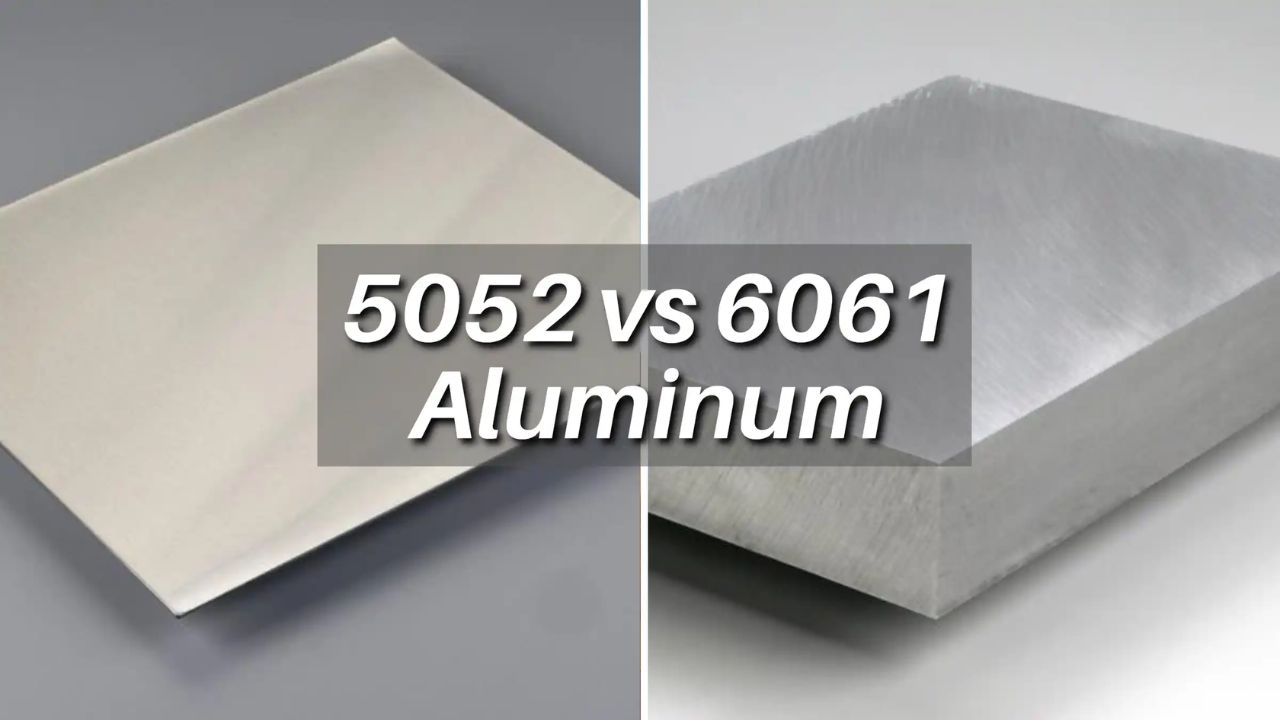
The properties of two grades of aluminum used in fabrication differ significantly. One is selected if strength and machining precision are required, while the other is selected if shaping and bending are important. If the wrong one is used, it can result in cracked bends, poor fit, or wasted materials. From the sheet metal planning stage onward, the choice of alloy is critical and, in many fabrication processes, affects the entire process. By comparing 6061 vs 5052 aluminum, stakeholders can make the right choice.
Basic Material Identity
The 5052 is an aluminum-magnesium alloy. 6061 is an aluminum-magnesium-silicon alloy. This composition difference in each alters the reactions during cutting and forming. 5052 is softer and easier to form. 6061 is harder and maintains shape under stress. Most performance differences come from these traits.
Strength Level Difference
6061 is a much stronger alloy than 5052. It is used in parts that are to be loaded without bending or deforming. 5052 may not be as strong, but it can be used for flexible panels and covers and can be molded without cracking. 6061 suits rigid and strong structures.
Bending and Forming Behavior
The 5052 is useful for bending and does not bend as tightly as others without damage. It is more uniform during forming, minimizing the risk of cracks in fold lines. 6061 is not like that and can break in sharp corners. This is why 5052 is often chosen for sheet parts that must be shaped after cutting.
Machining Behavior
The 6061 machine produces clean, stable chips, making it suitable for CNC and detailed parts. The 5052 is harder to cut and may soften under tool pressure, leading to inconsistent results. 6061 is often chosen in many workshops, including those at ShincoFab, for the manufacture of precision components due to its consistent machinability and ability to maintain tight tolerances across repeated runs.
Welding Behavior
Both alloys can be welded, but behave differently to heat. Being highly resistant to welding, 5052 retains much of its strength after welding, which is beneficial for sheet assemblies and joined panels. The 6061 material is weaker in the hot area around the weld and may result in structural loss if design changes are not implemented. This difference can influence the planning of joints in fabrication work.
Corrosion Resistance
5052 is superior in environments with moisture or salt. It is designed to withstand surface damage without heavy protection. 6061 can be used outside, but is more susceptible to surface wear with time if not treated. This makes 5052 more suitable for parts in outdoor or marine environments.
Weight and Density
There is no difference in the weight of the two alloys, only in performance under load. In structural parts, 6061 is stronger for a given weight. 5052 is easier to shape at similar weights, making it much easier to form a complex sheet design without adding structural load.
Surface Finish Behavior
Machining finishes are good for 6061 and can be anodized for extra protection and style. It is often used when a clean, controlled surface is needed after CNC work. 5052 is also suitable for coatings and is generally smoother when it comes in raw sheet. Surface choice often depends on whether the part is structural or decorative in function.
Cost and Sourcing Considerations
Overall, the raw material cost of 5052 is generally slightly lower, but sometimes processing costs are the factor that makes the difference. 6061 is more expensive to machine than 5052 but offers a more predictable response for precision parts. For projects managed by a team such as ShincoFab, the selection of materials often involves a trade-off between raw material cost and the time required to shape or machine them, as this will impact the overall project cost.
Common Applications
The 5052 alloy is widely used in sheet metal products such as panels, enclosures, and covers designed for outdoor use and requiring shaping. 6061 is used in structural frames, machine components, and precision components that require dimensional stability. The 5052 is typically used for formed parts, and 6061 for load-bearing or machined parts in the same project at ShincoFab.
Conclusion
6061 aluminum and 5052 aluminum are not direct competition but do play different roles. One is for strength and machining stability, the other is for forming ability and corrosion resistance. Knowing these differences will help prevent production problems and help plan materials throughout the production process. Choosing the proper alloy at the outset is often the most important factor in ensuring a design does not become bogged down in fabrication work at ShincoFab or be forced to change or be delayed.